Every year, thousands of Pennsylvanians turn 65 and face the same decision: Medicare Advantage or Medicare Supplement? It is one of the most consequential healthcare choices a person makes — and one of the most misunderstood.
The television commercials do not help. Neither do the comparison websites that rank plans by premium without explaining how those plans actually pay out when something serious happens. The result is that most people in central Pennsylvania make this decision without the full picture — and some spend years paying for a plan that does not fit their health situation.
This guide is written to give you that full picture. It explains how each option works, who each one is right for, and what questions to ask before making a decision. If you are approaching Medicare eligibility in Lancaster County, York County, Dauphin County, or anywhere in central Pennsylvania, this is the comparison that matters.
What Medicare Actually Covers — Before You Choose Anything
Medicare itself — what the government calls Original Medicare — has two main parts. Part A covers hospital stays, skilled nursing facility care, and some home health services. Part B covers outpatient care, doctor visits, preventive services, and medical equipment.
Original Medicare does not have an out-of-pocket maximum. If something serious happens — a hospitalization, a surgery, a prolonged illness — the 20% coinsurance on Part B charges alone can reach tens of thousands of dollars with no cap. This is the gap that Medicare Advantage and Medicare Supplement plans exist to fill. They fill it in very different ways.
How Medicare Advantage Works
Medicare Advantage plans — also called Part C — are offered by private insurance companies approved by Medicare. When you enroll in a Medicare Advantage plan, you are still in Medicare, but the private insurer manages and pays your claims instead of the federal government.
Most Medicare Advantage plans bundle hospital coverage (Part A), medical coverage (Part B), and prescription drug coverage (Part D) into a single plan. Many also include extras like dental, vision, hearing, and fitness benefits — benefits Original Medicare does not cover.
What you gain with Medicare Advantage:
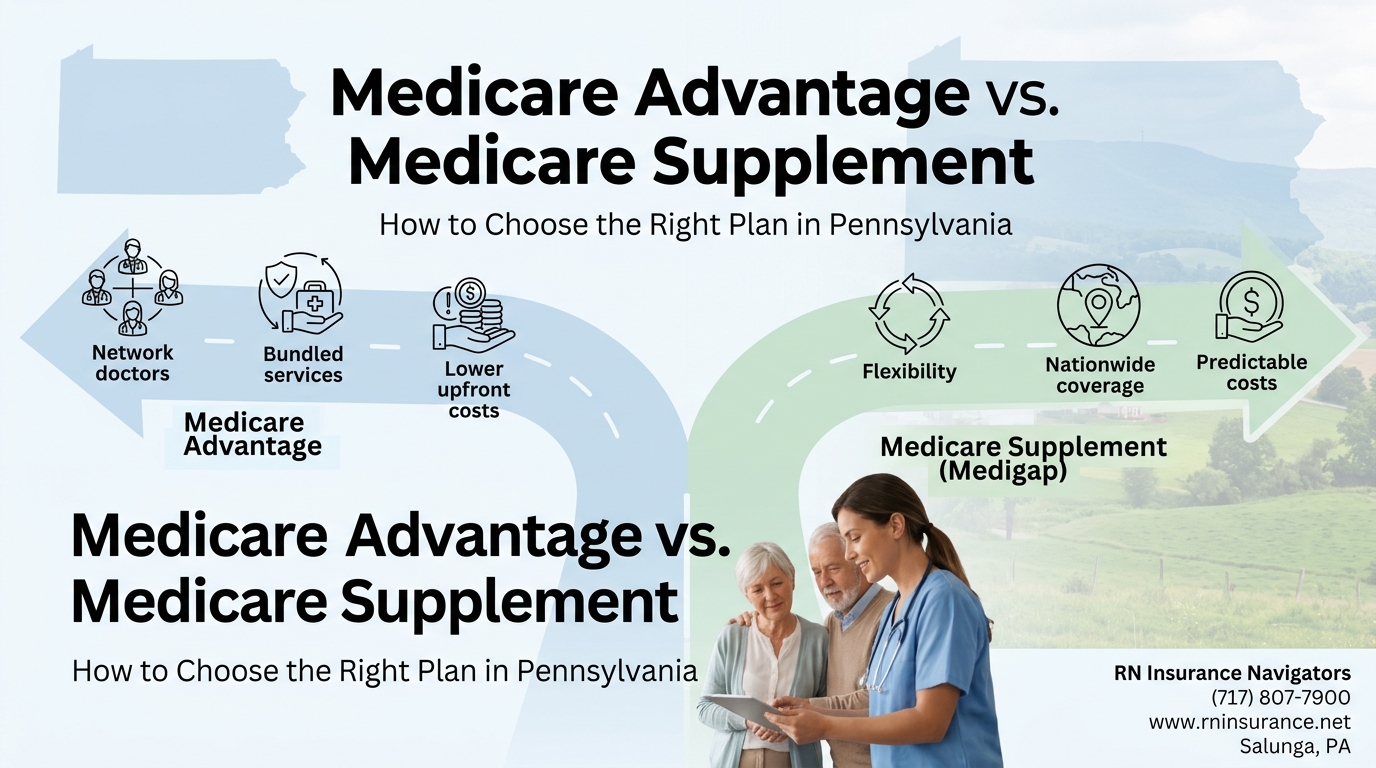
- Lower monthly premiums — many plans in central Pennsylvania have $0 or low monthly premiums beyond what you pay for Part B
- Prescription drug coverage included in most plans
- Additional benefits like dental and vision
- An out-of-pocket maximum that caps your annual exposure
What you trade for it:
- A network — you generally must see doctors and use hospitals within the plan's network, or pay significantly more for out-of-network care
- Prior authorization requirements — the plan can require approval before certain procedures, referrals, or specialist visits
- Annual plan changes — benefits, networks, and formularies can change every year, requiring an annual review to confirm your plan still fits
For central Pennsylvania residents, Medicare Advantage options vary by county. Lancaster County is served by carriers including Geisinger Health Plan, Capital BlueCross, Highmark, UPMC Health Plan, UnitedHealthcare, and Aetna — each with different networks, different formularies, and different cost-sharing structures. Which carriers include Lancaster General Hospital, WellSpan, or Penn State Health Hershey Medical Center in their networks depends on the specific plan and year.
How Medicare Supplement Works
Medicare Supplement plans — also called Medigap — work alongside Original Medicare rather than replacing it. When you have a Medicare Supplement plan, Original Medicare pays its share of a covered service, and your Medigap plan pays some or all of what is left — reducing or eliminating your out-of-pocket costs.
Medigap plans are standardized by Medicare. A Plan G from one insurance company covers exactly the same benefits as a Plan G from any other company. The differences between carriers are premium, rate increase history, and financial stability — not benefits.
The most common plans in Pennsylvania:
- Plan G — the most comprehensive plan available to new enrollees after January 1, 2020. Covers everything Original Medicare covers except the Part B deductible (currently $257/year in 2026). After that deductible, most covered services have no additional out-of-pocket cost.
- Plan N — covers most of what Plan G covers, but includes a $20 copay for office visits and $50 for emergency room visits. Lower monthly premium than Plan G in exchange for those copays.
What you gain with Medicare Supplement:
- Freedom to see any doctor or specialist who accepts Medicare — nationwide, without network restrictions
- No prior authorization requirements in most cases
- Predictable, capped out-of-pocket costs
- Stability — benefits do not change year to year
What you trade for it:
- Higher monthly premiums than most Medicare Advantage plans
- No prescription drug coverage included — you must purchase a standalone Part D plan
- No extras like dental or vision
The Comparison That Actually Matters: Total Annual Cost
The most common mistake people make when comparing these options is looking only at the monthly premium. The right question is not "which plan is cheaper per month?" It is "which plan costs me less across the year — including what I would actually pay if something goes wrong?"
A Medicare Advantage plan with a $0 monthly premium and a $7,550 out-of-pocket maximum is not the same as a $0 monthly premium with no maximum. And a Medicare Supplement Plan G at $150 per month looks expensive until you realize that after the Part B deductible, most of your covered care costs nothing.
The math depends on:
- How often you use healthcare — routine care vs. ongoing management of chronic conditions vs. infrequent but unpredictable major events
- Which doctors and hospitals you need in-network
- Which medications you take and how they are covered under each plan's formulary
- Your tolerance for uncertainty — a fixed monthly premium vs. variable out-of-pocket costs
There is no universally correct answer. The right plan is the one that fits your health situation, your financial picture, and your care preferences — not the one with the lowest premium or the most television commercials.
Who Medicare Advantage Tends to Fit
Medicare Advantage tends to work well for people who:
- Are generally healthy and use healthcare infrequently
- Are comfortable staying within a network and navigating prior authorization
- Want drug, dental, and vision coverage bundled into one plan
- Prefer lower monthly premiums and are willing to accept some out-of-pocket exposure
- Live primarily in one area and do not travel extensively
Who Medicare Supplement Tends to Fit
Medicare Supplement tends to work well for people who:
- Manage ongoing or complex health conditions that require frequent specialist visits or procedures
- Have strong preferences about which doctors and hospitals they see
- Travel frequently or split time between locations
- Want to minimize financial uncertainty and unpredictable out-of-pocket costs
- Are willing to pay a higher monthly premium in exchange for simplicity and stability
Pennsylvania-Specific Considerations
Pennsylvania residents have some additional protections worth knowing:
Medigap guaranteed issue rights beyond the standard open enrollment window exist for specific circumstances — including plan termination, loss of employer coverage, and other qualifying life events. Pennsylvania also has protections related to excess charges that affect which Medigap plan provides the most complete coverage.
Medicare Advantage networks in central Pennsylvania vary significantly by carrier and plan year. A plan that includes Lancaster General Hospital in its network this year may restructure its network next year. Annual review — before October 15 each year — is essential for anyone on Medicare Advantage.
The birthday rule does not currently apply in Pennsylvania the way it does in some other states — which affects the options available to people who want to switch Medigap plans after their initial open enrollment window closes.
The Role of Annual Enrollment Period
Every year from October 15 through December 7, Medicare beneficiaries can switch Medicare Advantage plans, switch from Medicare Advantage back to Original Medicare, or make changes to their Part D drug plan. Changes take effect January 1.
This window matters because plans change. A Medicare Advantage plan that was the right fit last year may have changed its formulary, restructured its network, or increased its out-of-pocket maximum. An annual review before October 15 — not after the window opens — is the right time to compare.
How RN Insurance Navigators Approaches This Decision
Wendy Tribioli is a Registered Nurse and independent licensed insurance agent serving central Pennsylvania from her office in Salunga, Lancaster County. Before recommending any Medicare plan, she works through each client's situation the way a nurse approaches a patient assessment — starting with health history, current medications, preferred providers, and financial priorities before a single plan is mentioned.
Because she is independent and not affiliated with any insurance carrier, her recommendations reflect what actually fits the client's situation — not what pays the highest commission or meets a monthly enrollment quota. She is licensed with multiple carriers serving Lancaster, York, and Dauphin Counties and can compare options across the full local market.
Wendy also conducts annual reviews for existing Medicare clients each fall before the Annual Enrollment Period opens — so clients are not navigating plan changes alone when formularies shift or network updates arrive.
Frequently Asked Questions
Is Medicare Advantage or Medicare Supplement better in Pennsylvania? There is no single answer. Medicare Advantage is often a better fit for healthier individuals who prefer lower premiums and are comfortable with network restrictions. Medicare Supplement is often better for people managing ongoing health conditions who want predictable costs and freedom to see any Medicare-accepting provider. The right answer depends on your specific health, financial, and care situation.
Can I switch from Medicare Advantage to Medicare Supplement in Pennsylvania? Yes — during the Annual Enrollment Period (October 15–December 7) you can switch from Medicare Advantage back to Original Medicare. However, switching to a Medicare Supplement plan after your initial Medigap open enrollment window may require medical underwriting unless a guaranteed issue right applies to your situation.
Do Medicare Advantage plans in Lancaster County cover Lancaster General Hospital? Network participation varies by plan and year. Not all Medicare Advantage plans serving Lancaster County include Lancaster General Hospital / Penn Medicine Lancaster General in their networks. This is one of the first things to verify before enrolling in any Medicare Advantage plan — and one of the first things Wendy checks on behalf of every Medicare client.
How much does Medicare Supplement Plan G cost in Pennsylvania? Premiums vary by age, carrier, tobacco use, and household discount eligibility. In central Pennsylvania, Plan G premiums for a 65-year-old typically range from approximately $100–$200/month depending on the carrier. Premiums increase with age, which is why carrier rate increase history matters when choosing a Medigap plan.
Ready to Compare Your Medicare Options?
Choosing between Medicare Advantage and Medicare Supplement is not a decision that should be made based on a television commercial or a website comparison table. It is a decision that should be made based on your health, your doctors, your medications, and your financial situation — with someone who knows the plans available in your specific part of Pennsylvania.
RN Insurance Navigators serves clients in Lancaster, York, Hershey, and across Lancaster County, York County, and Dauphin County. In-person consultations are available at 45 W. Brandt Blvd., Salunga, PA 17538, Monday through Friday, 9am to 5pm.
Request a Medicare Consultation Call 717-807-7900
Wendy Tribioli is a Registered Nurse and licensed independent insurance agent serving central Pennsylvania. RN Insurance Navigators is not affiliated with or endorsed by the federal Medicare program or any insurance carrier.